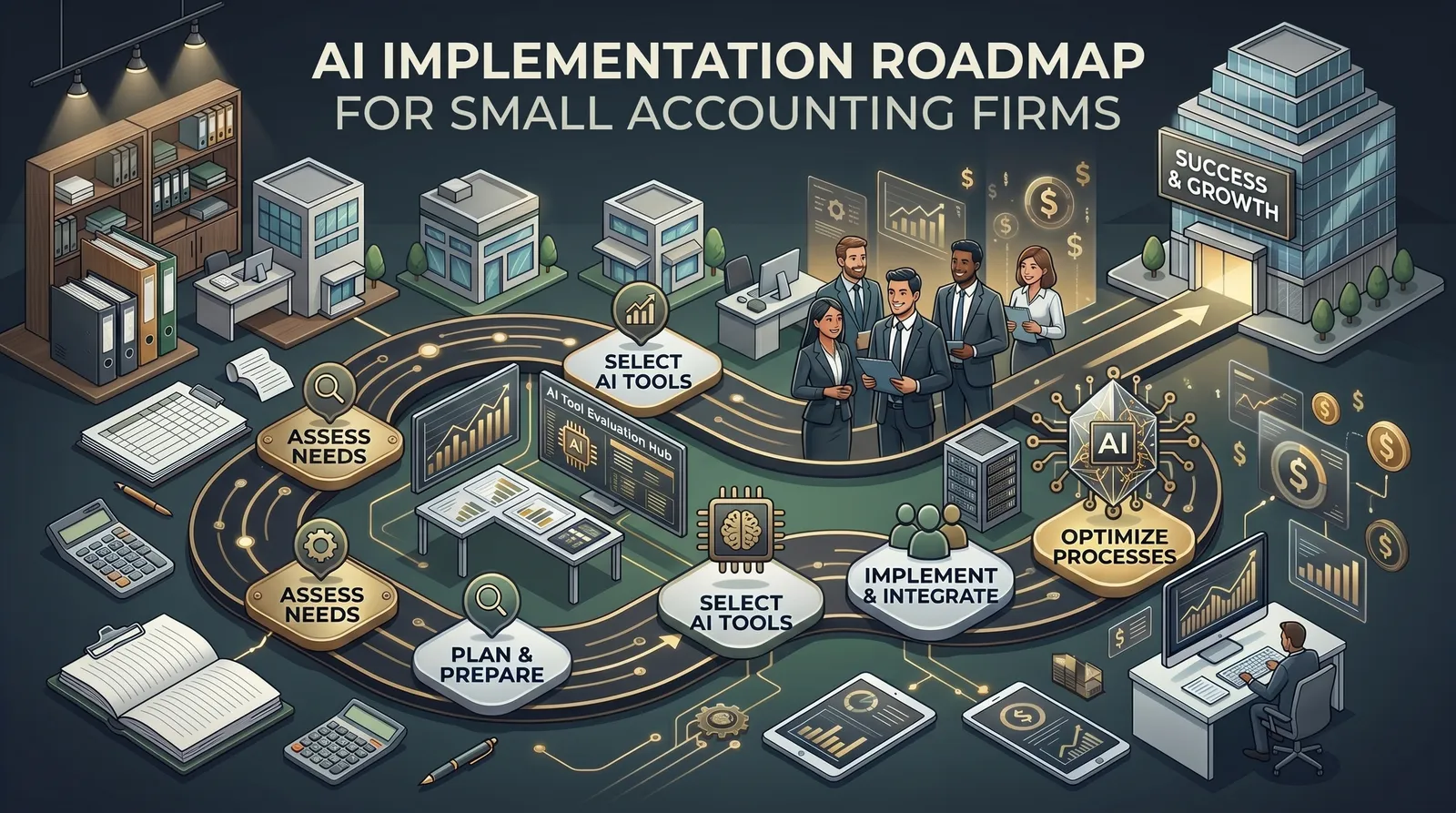
Small businesses waste an average of $47,000 annually on failed technology implementations, yet 83% of successful AI adopters started with budgets under $10,000 and a structured approach. The difference isn't the size of their budget—it's having a clear AI implementation roadmap for small business that matches their resources to realistic outcomes. This month-by-month framework shows you exactly how to deploy AI solutions that deliver measurable results without breaking your cash flow or overwhelming your team.
Month 1-2: AI Readiness Assessment and Goal Setting
Start your AI adoption strategy SMB with a thorough assessment of your current operations. Document three specific business problems that consume the most time or generate the highest error rates. Common examples include customer service response delays, invoice processing bottlenecks, or inventory tracking inefficiencies.
Create a simple scoring matrix rating each problem on impact (1-5) and AI suitability (1-5). Problems scoring 7+ become your priority targets. For a retail business, this might be automated customer inquiries about order status. For professional services, it could be appointment scheduling and client intake.
Establish baseline metrics for your priority problems. If customer service emails take an average of 4 hours to respond, or invoice processing requires 2 hours daily, document these numbers. You'll track improvement against these baselines throughout your implementation.
Set a realistic budget ceiling—most successful small business AI transformations start between $3,000-$8,000 for the first year. Allocate 60% for software subscriptions, 25% for training and setup time, and 15% as a buffer for unexpected adjustments.
Month 3-4: Budget Allocation and Tool Selection by Industry
Your AI transformation plan small business requires industry-specific tool selection. Different business types see faster returns from different AI applications:
Retail businesses should prioritize customer service chatbots and inventory prediction tools. Budget $200-400 monthly for customer service AI and $100-200 for inventory optimization software.
Professional services benefit most from scheduling automation and document processing. Allocate $150-300 monthly for appointment management AI and $200-400 for contract and proposal automation.
Manufacturing and trades see immediate returns from predictive maintenance alerts and job scheduling optimization. Budget $300-500 monthly for equipment monitoring and $150-250 for workforce scheduling AI.
Service businesses gain efficiency through lead qualification and customer onboarding automation. Plan $200-350 monthly for CRM integration and $150-300 for automated follow-up sequences.
Research vendors offering free trials or month-to-month pricing. Avoid annual commitments until Month 6, when you've validated actual usage patterns and ROI.
Month 5-6: Pilot Implementation and Team Training
Launch your AI implementation checklist with a single, high-impact pilot project. Choose the problem with the highest score from your Month 1 assessment and implement one solution completely before adding others.
Deploy your pilot with 20% of relevant workload initially. If implementing customer service AI, route every fifth inquiry through the system while handling others manually. This approach lets you troubleshoot issues without disrupting operations.
Train your team using the "train-the-trainer" method. Select one tech-savvy employee to become your AI champion. They receive intensive training (budget 8-10 hours) and then train colleagues in 2-hour sessions. This approach costs 70% less than external training for your entire team.
Track three specific metrics during pilot phase: time savings, error reduction, and user satisfaction. Document weekly progress in a simple spreadsheet. Successful pilots typically show 15-30% improvement in targeted metrics within 30 days.
Month 7-8: Scaling AI Solutions Across Operations
Expand your successful pilot to handle 80% of relevant workload. Use the confidence gained from pilot success to introduce a second AI solution targeting your next highest-priority problem.
Implement your business AI integration steps systematically. If your customer service pilot succeeded, add automated appointment scheduling or inventory alerts. Layer solutions gradually rather than deploying multiple systems simultaneously.
Create standard operating procedures for each AI tool. Document when staff should intervene, how to handle system errors, and escalation protocols. Keep procedures to single-page format with bullet points and screenshots.
Begin staff cross-training so multiple employees can manage each AI system. This prevents single-point-of-failure scenarios that plague small businesses when key personnel are unavailable.
Month 9-10: Performance Monitoring and Optimization
Establish weekly performance reviews using your baseline metrics from Month 1. Create a simple dashboard tracking cost savings, time reduction, and error prevention for each AI solution.
Calculate your return on investment using concrete numbers. If customer service AI saves 2 hours daily at $15/hour loaded cost, that's $150 weekly savings or $7,800 annually—easily justifying a $3,000 annual tool cost.
Optimize AI configurations based on actual usage patterns. Most platforms offer advanced settings that improve performance once you understand your specific workflows. Dedicate 2-3 hours monthly to configuration refinements.
Begin planning expansion to address remaining inefficiencies identified in Month 1. Your AI deployment framework SMB should now include lessons learned and refined budget allocations based on actual costs and returns.
Month 11-12: Advanced Integration and Future Planning
Connect your AI tools to create workflow automation chains. For example, link customer service AI with scheduling systems so resolved inquiries automatically trigger appointment booking options.
Evaluate your AI adoption timeline small business against industry benchmarks. Successful implementations typically achieve 25-40% productivity improvements in targeted processes and 15-20% cost reductions in operational areas.
Plan year-two expansion based on demonstrated ROI. If first-year AI investments generated 200%+ returns, budget 50% more for additional solutions. If returns were 100-150%, maintain current investment levels while optimizing existing tools.
Create a succession plan for AI management. Document procedures, vendor relationships, and optimization techniques so your business isn't dependent on single individuals for AI operations.
Consider advanced solutions like LetsAdoptAi Chat for enhanced customer interactions, LetsAdoptAi Voice for phone automation, or LetsAdoptAi Agent for complex customer service scenarios, but only after mastering foundational implementations.
Your AI Implementation Success Formula
This roadmap transforms AI from overwhelming technology buzzword into manageable monthly objectives. The key lies in matching your ambitions to your resources while building competence systematically. Start small, measure everything, and scale based on proven results rather than promises. Your first successful AI implementation creates the foundation and confidence for increasingly sophisticated automation that grows with your business.
 5 min read
Jun 14, 2026
5 min read
Jun 14, 2026